A team led by Prof. Guojun Wu at the Xi’an Institute of Optics and Precision Mechanics (XIOPM) of the Chinese Academy of Sciences (CAS) has developed PGF-ULB, a physics-guided, geometry-constrained fusion framework for underwater light-beacon salient object detection and localization which aids optical docking of autonomous underwater vehicles (AUVs) in complex water environments. The study appears in Information Fusion, Yuhong Miao, an engineer at XIOPM, is the first author and Prof.Wu is corresponding author.
Optical docking underpins long-endurance marine tasks such as persistent underwater observation, infrastructure inspection, and resource exploration, and its reliability depends on accurately detecting and localizing the docking station’s light beacons. Yet absorption and scattering by water and suspended particles blur and distort beacon images, to an extent that varies with turbidity, illumination, and distance. Conventional methods are insufficiently robust, while deep-learning approaches demand large annotated datasets and GPU resources rarely available aboard AUVs.
PGF-ULB couples physics guidance with geometric constraints. An underwater imaging physical model suppresses backscatter and attenuates forward-scattering halos to highlight the beacon body; the beacon’s radial symmetry yields degradation-robust structural cues; and a conditional random field adaptively fuses the two cues based on their confidence. Requiring no training or manual tuning, it runs in real time on an ordinary CPU and is readily deployable on an AUV.
Based on lake and nearshore sea trials, the team built ULBSOD, a benchmark of 800 pixel-level annotated images of bottom-mounted, cage-type, and grab-type docking stations under varied turbidity, illumination, and target-scale conditions. Compared with nine traditional, deep-learning, and underwater-specific methods, PGF-ULB achieved 100% detection success rate, an F1 score of 0.996, a sub-pixel mean centroid error of 0.384 pixels, and an S-measure of 0.927, leading all competing methods on all major metrics.
Integrated into a monocular pose-estimation pipeline for realistic docking trials, PGF-ULB raised pose availability from 86.13% with the best deep-learning baseline (U2-Net) to 99.52%, and produced smooth trajectories converging to the station, supplying continuous pose information for automated docking control.
“Underwater docking is like berthing a ship: the vehicle must precisely identify the station’s ‘signal lamp’,” said Prof.Wu. “This technique gives the vision system both a ‘dehazing filter’ and a ‘shape verifier’ that corroborate each other, locking the target accurately even in turbid water.”
The work offers an interpretable, efficient, AUV-deployable route to robust beacon perception, with potential use in three-dimensional marine observation, underwater engineering operations and maintenance, and resource development. The study was supported by the National Key R&D Program of China.
(Published 6 September 2026)
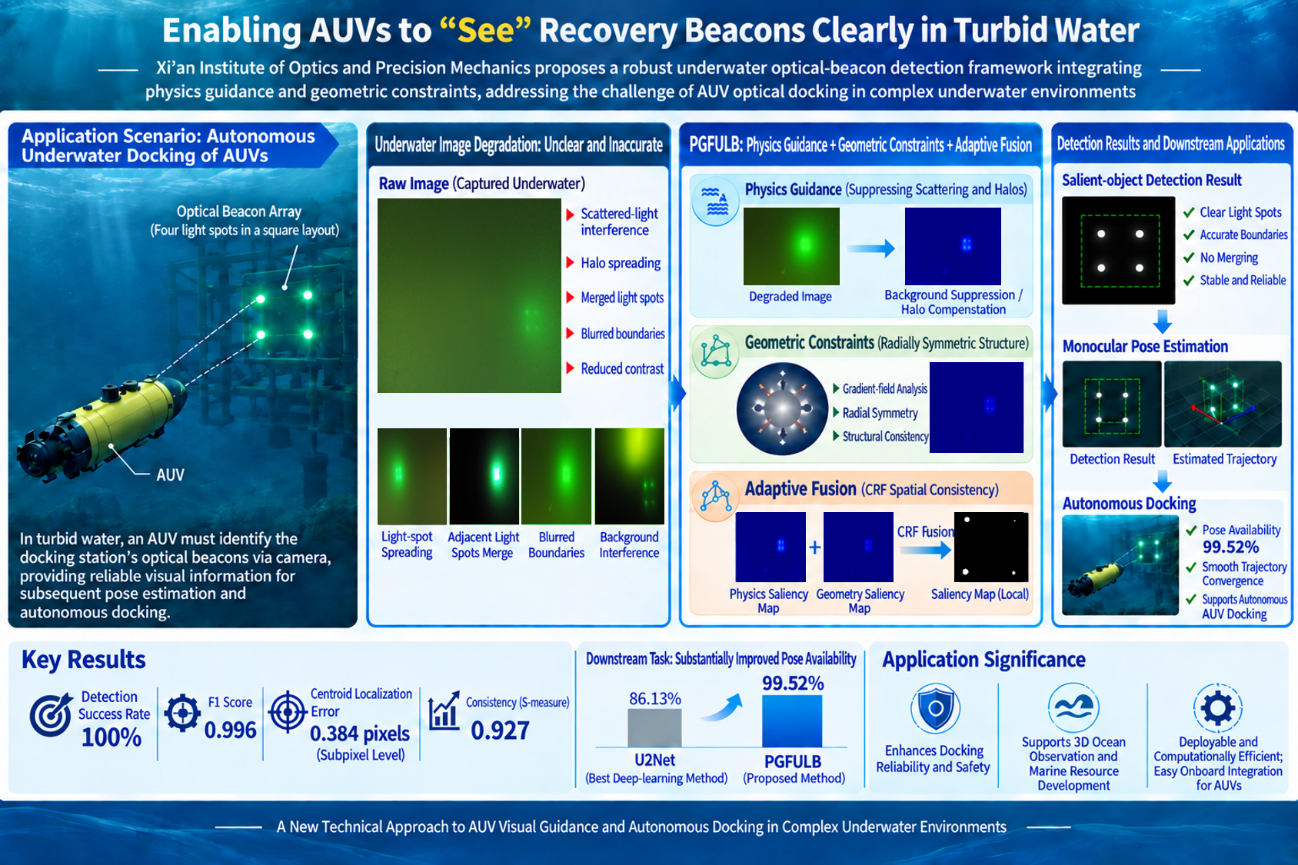
Figure. Schematic of robust underwater light-beacon detection for AUV optical docking. (Image by XIOPM)
Download: