In a study published in Ultrafast Science, a research team from the Xi'an Institute of Optics and Precision Mechanics (XIOPM) of the Chinese Academy of Sciences, along with collaborators from the Institute National de la Recherche Scientifique, Canada, and Northwest University, developed a single-shot compressed upconversion photoluminescence lifetime imaging (sCUPLI) system for high-speed imaging.
High-fidelity recovery from complex inverse problems remains a key challenge in compressed high-speed imaging. Deep learning has revolutionized the reconstruction, but pure end-to-end "black-box" networks often suffer from structural artifacts and high costs. To address these issues, the team from XIOPM proposed a multi-prior physics-enhanced neural network (mPEN).
By integrating mPEN with compressed optical streak ultra-high-speed photography (COSUP), the researchers developed the sCUPLI system. This system utilized an encoding path for temporal shearing and a prior path to record unencoded integral images. It effectively suppressed artifacts and corrected spatial distortion by synergistically correcting multiple complementary priors including physical models, sparsity constraints, and deep image priors.
Technical analysis revealed that the mPEN-sCUPLI achieved a spatial resolution of 90.5 lp/mm at 33,000 fps, representing an approximately 3.56-fold improvement over the TwIST-based COSUP method. Furthermore, it improved the average peak signal-to-noise ratio (PSNR) by 4 dB and enhanced imaging sharpness and fidelity by 1.85 times.
The researchers applied this system to food safety detection. Using rare-earth-doped upconversion nanoprobes, the system achieved the non-destructive and rapid detection of synthetic colorant concentrations in alcohol solutions by capturing microsecond-scale fluorescence lifetime variations.
"This study advances compressed imaging toward higher clarity and practical utility, showing potential in food safety and biomedical measurements," said Profs. BAI Chen and YAO Baoli. "We expect the mPEN-sCUPLI to be widely employed in quantitative detection applications for its ability to achieve high fidelity and throughput from single-shot measurements."
(published: 6 January 2026)
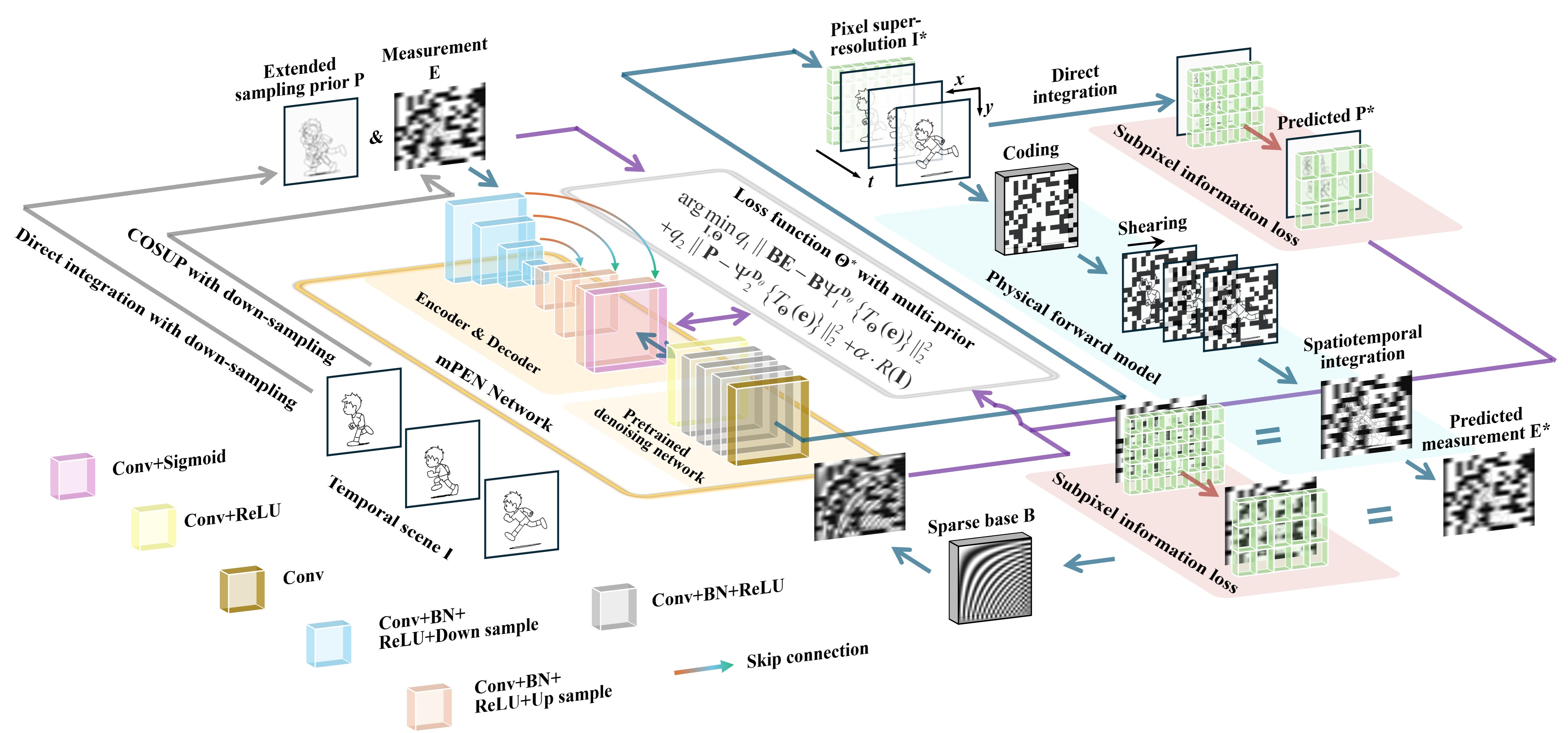
Figure. Schematic of the AI-powered mPEN-sCUPLI reconstruction framework. (Image by XIOPM)
Download: