Spatial heterodyne Raman spectroscopy is a powerful tool for high-resolution spectral detection but is often hindered by weak signals, noise, and complex baselines caused by instrumental and environmental factors. It's difficult for traditional methods to handle noise and baseline distortion simultaneously without human intervention, and they are often ineffective in preserving fine spectral features.
A research team led by Prof. WANG Quan from the Xi’an Institute of Optics and Precision Mechanics (XIOPM) of Chinese Academy of Sciences has introduced the InDNet for simultaneous denoising and baseline correction of spatial heterodyne interference data. The new approach leverages a multi-scale convolutional network combined with a Transformer architecture and a novel multidimensional gradient-consistent regularization strategy to significantly enhance signal quality in Raman spectroscopy. Their findings were published in Optics and Laser Technology.
Researchers developed a comprehensive interferogram simulation model that generates realistic training data, effectively tackling the scarcity of labeled experimental data. InDNet, the proposed multi-level signal enhancement network model, is integrated with multi-scale local feature extraction and global context modeling via Transformer blocks. The model is further guided by a multidimensional gradient-consistent regularization loss, which enhances structural consistency in interferograms and improves spectral recovery.
The experimental results of InDNet demonstrate outstanding performance on simulated, pseudo-label, and real-world datasets. The method achieved Structural Similarity Index values of 0.9757 and 0.9827 on simulated and real data, respectively, significantly outperforming state-of-the-art techniques such as Pyramid Detection Network (PDNet) and Lightweight Residual Dense U-net (LRDUNet). The InDNet also excelled in recovering weak signals with Signal-to-Noise Ratio ≤ 3, showing strong potential for real-world applications such as biomedical sensing, material analysis, and chemical detection.
This study provides a robust solution for interference data enhancement. Additionally, it presents a generalizable simulation-to-real framework. This framework can be applied to various high-resolution spectroscopic systems. In this way, it opens the door to fully automated, high-precision spectral processing without manual parameter tuning.
(Available online 9 September 2025)
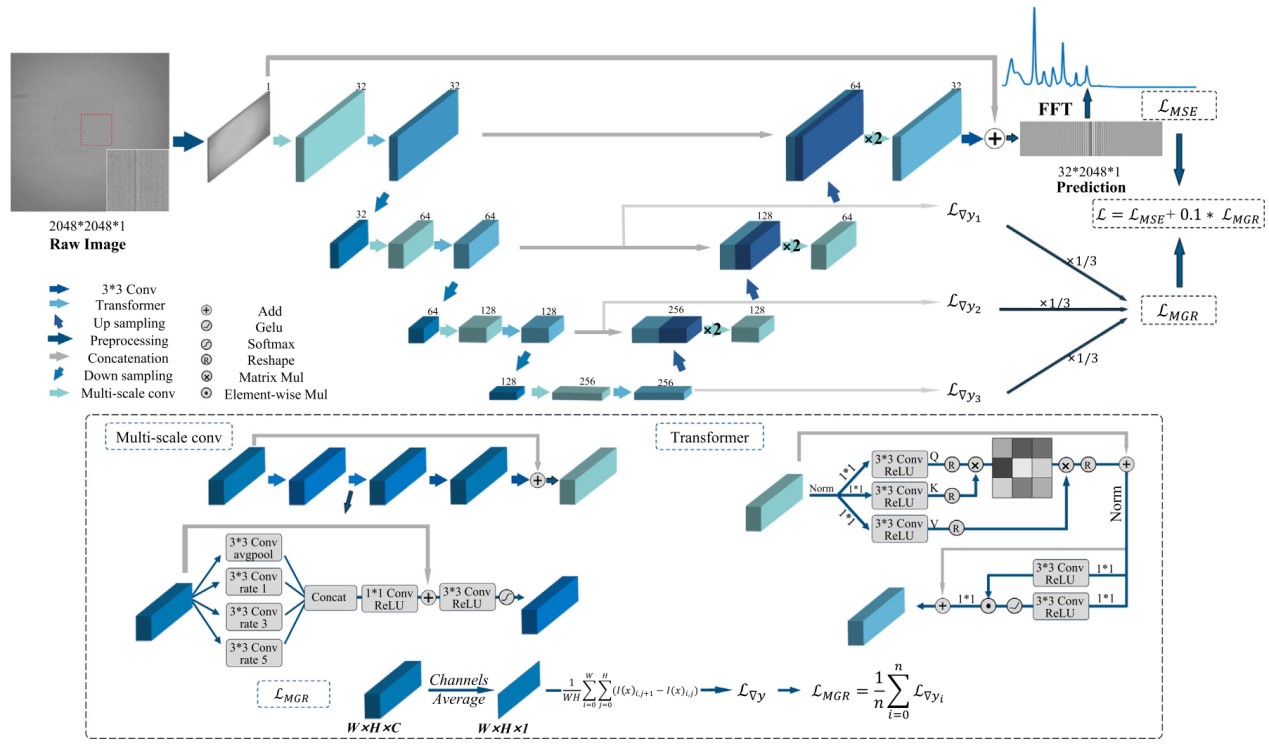
Fig. Overall of the network architecture of InDNet. (Image by XIOPM)
Download: