In a study published in Chaos, Solitons and Fractals, a team leb by Prof. GUO Haitao from the Xi’an Institute of Optics and Precision Mechanics (XIOPM) of the Chinese Academy of Sciences revealed the nonlinear dynamics of double-periodic pulsating solitons in a 2.8 μm mid-infrared fiber laser. This wavelength band is promising for molecular spectroscopy, ultrafast imaging, and precision materials processing, due to its high efficiency, good beam quality and broad bandwidth.
Strong nonlinear effects and complex dispersion control make pulse formation difficult to predict, hindering practical laser optimization. To address this challenge, the team developed a theoretical model based on the Ginzburg–Landau equation and simulated pulse evolution in a 2.8 μm Er-doped fluoride fiber system. By varying the gain saturation energy, they identified transitions from single pulses to pulsating solitons, bound states, and multi-soliton molecules. A key discovery was the double-periodic pulsating soliton, which features fast oscillations modulated by a slower envelope. This reflects the interplay among nonlinearity, dispersion, and gain in mid-infrared systems.
The team then built a 2.8 μm mode-locked fiber laser and experimentally observed the predicted solitons. Short-period oscillations ranged from 3 to 13 round trips, while long-period envelopes extended from 25 to 823 round trips. Transitions to stable multi-soliton molecules containing three or four pulses were also achieved. The experiments confirmed that short-period oscillations remain stable while long periods increase with pump power, aligning with the theoretical model.
"This work deepens understanding of mid-infrared ultrafast pulse dynamics and proposes new strategies for laser optimization, opening avenues for precise control in next-generation ultrafast systems," said Prof. GUO Haitao from XIOPM.
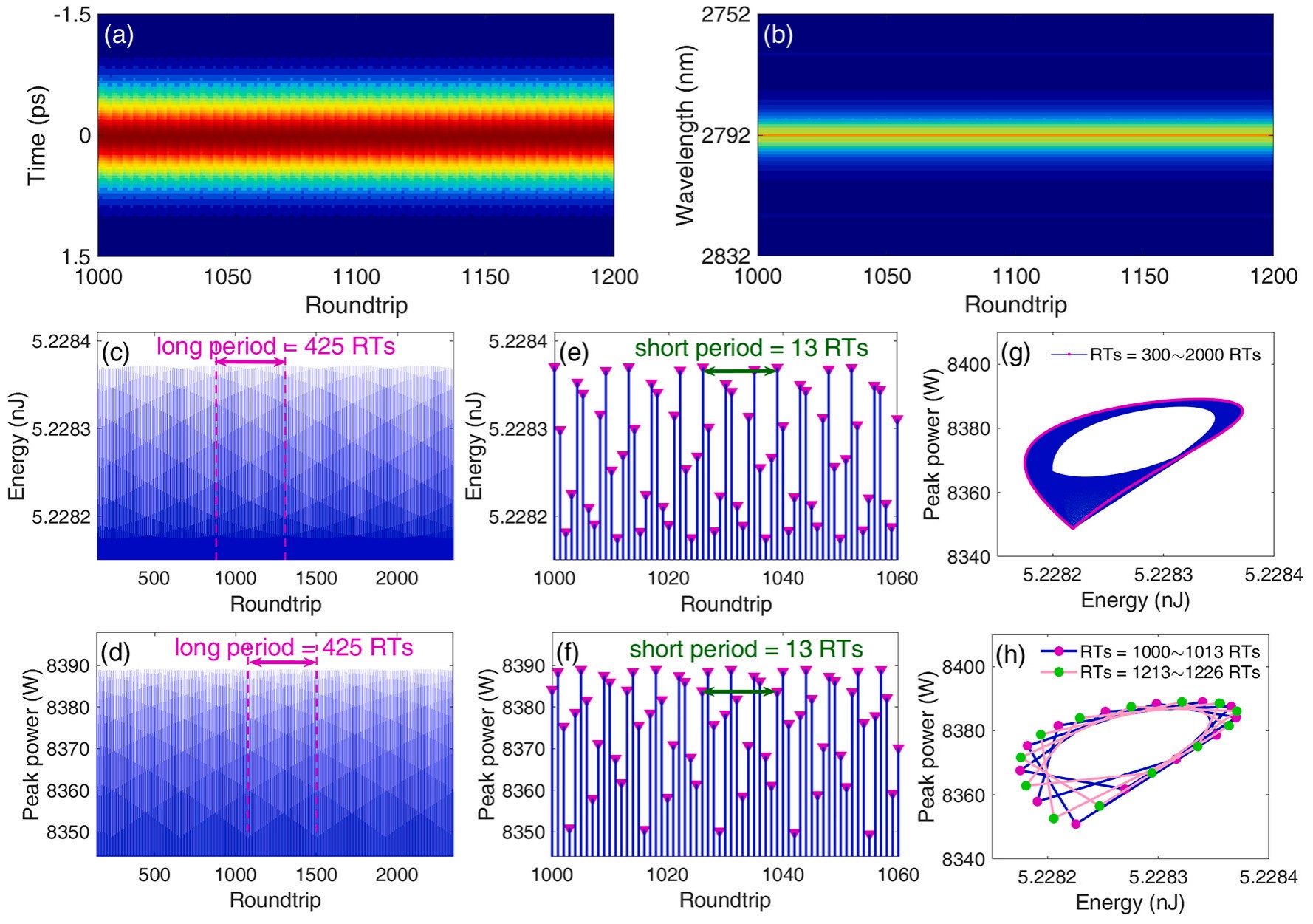
Fig. Evolution of the characteristics of dual-period pulsating solitons. (Image by DONG Yuhe)
Download: