Traditionally, metallic metasurfaces were used for field enhancement, but their performance was limited by high ohmic losses and low laser damage thresholds. Although dielectric metasurfaces have lower losses, they still face challenges in in fully confining light.
In a study published in Nanoscale Horizons, a research team led by Prof. LIU Hongjun from Xi’an Institute of Optics and Precision Mechanics of the Chinese Academy of Sciences has proposed a novel method to enhance near-field electric field by using amorphous metasurfaces.
This novel method can overcome conventional methods limitations by leveraging the unique properties of Friedrich-Wintgen bound states in the continuum (FW-BICs) and hybrid magnetic dipole (MD) modes, achieving both high field enhancement and stability.
The researchers designed a non-vertically symmetric silicon metasurface that modulates two FW-BICs to create a hybrid MD mode with a super flat band. This mode exhibits a low group velocity of 16,731 m/s and a high quality factor (Q-factor) of 217, enabling strong light-matter interaction and significant electric field enhancement. The maximum near-field enhancement can reach 808 times. And the third harmonic conversion efficiency is 10-4 at a pump intensity of 10 MW/cm2, significantly reducing the power requirements compared to conventional methods.
"This work provides a new pathway for achieving strong near-field enhancement and efficient nonlinear effects in nanophotonic devices, the findings could pave the way for advancements in optical sensing, wavefront control, and integrated photonic circuits ." said Prof. LIU Hongjun.
(published June 11,2025)
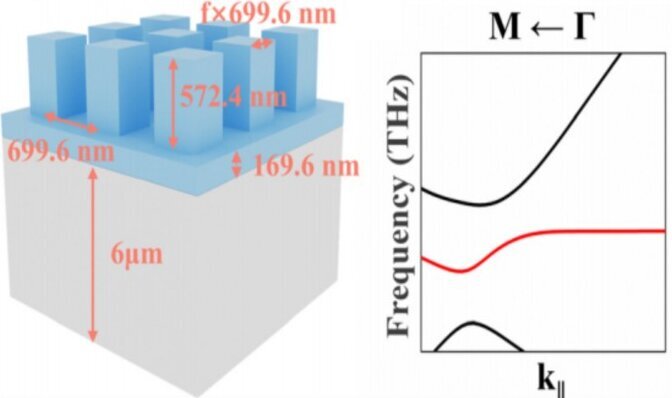
Fig. Sketches of non-vertical metasurfaces composed of a periodic array structure. (Image by XIOPM)
Download: